AI Implementation & Adoption Guide
AI adoption strategies, operating models, costs & ROI, organizational change, and governance — based on Book Part 4 of the AI Best Practices for Commerce reference.
Introduction: From Vision to Execution
Turning possibility into predictable performance
From Inspiration to Implementation
By now, the opportunity is clear. The previous chapters explored how AI transforms two of the major value streams of modern enterprise—Commerce and Software Development—revealing what’s possible when intelligence becomes embedded in daily operations. But inspiration alone doesn’t build maturity. The next challenge is turning possibility into predictable performance.
Across industries, leading organizations demonstrate how this transition occurs. Walmart is one example. In public earnings commentary and operational briefings, the company has detailed how its AI-driven forecasting and replenishment systems strengthen in-stock availability, reduce markdowns, and support the rapid expansion of store-fulfilled ecommerce. These improvements stem from years of coordinated investment in data quality, inventory visibility, and machine-learning-powered supply chain execution—illustrating how AI maturity accelerates when operational discipline meets strategic intent.
This chapter moves from what AI can do to how organizations make it real. It translates the vision of intelligent enterprise into a set of scalable, repeatable practices for implementation, adoption, and governance. Deere & Company offers another example of this progression. Through public product announcements and presentations to analysts, Deere has shown how its autonomous 8R tractor, computer-vision guidance systems, and Precision Agriculture platform emerged from long-term alignment across hardware engineering, software development, and AI research. These systems rely on onboard inference, advanced sensing, and cloud-based agronomic intelligence— capabilities the company has deliberately built over many years. Deere’s trajectory underscores how AI success compounds when strategy, data foundations, and technical capability evolve together.
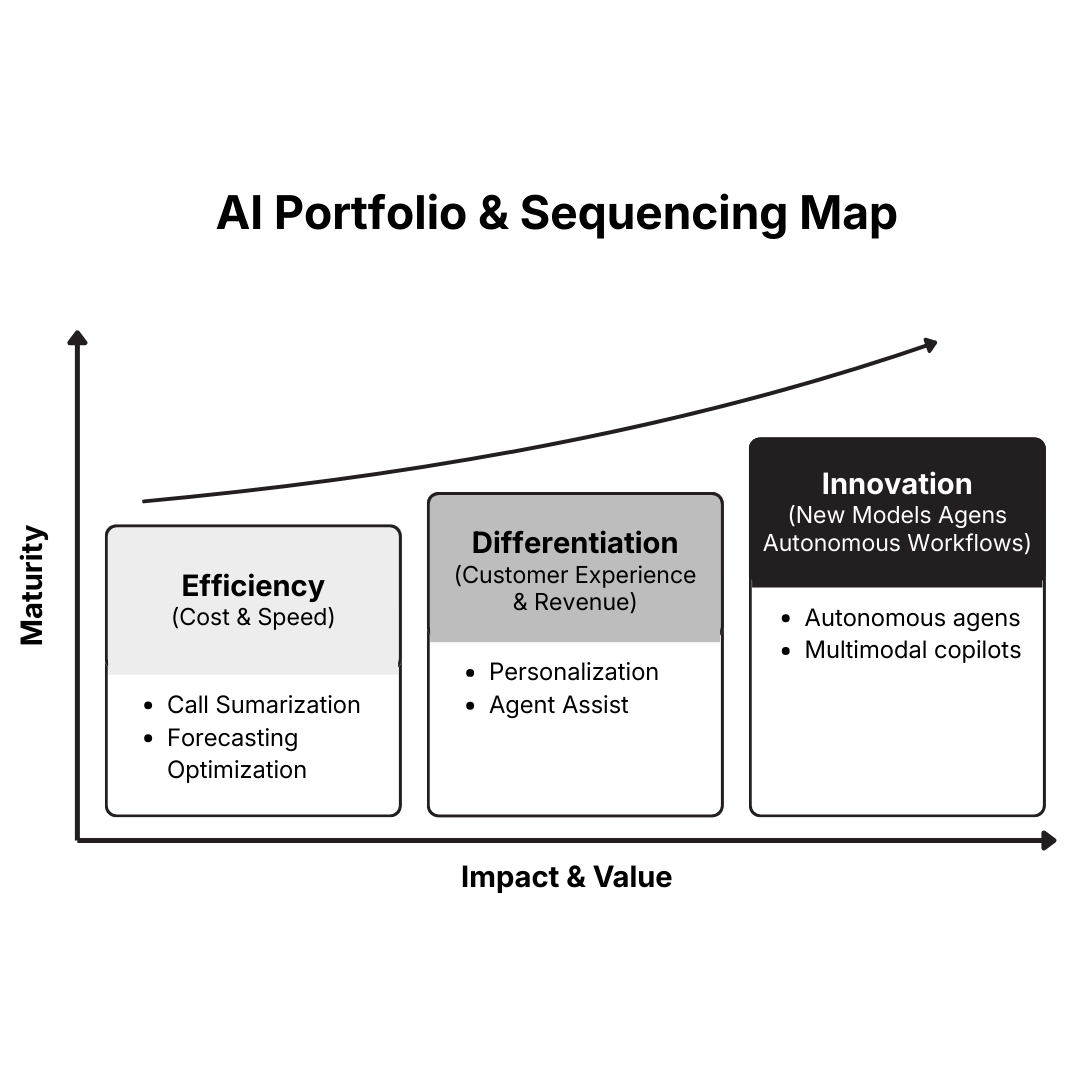
AI implementation is not a single program—it’s a portfolio. Some initiatives drive efficiency, others differentiation. Some deliver immediate value; others build future capability. The art of implementation lies in sequencing: investing in the right opportunities at the right time with the right people and processes in place.
And yet, even the most technically sound programs stumble without strategic alignment. Without clear linkage between AI use cases and business objectives, efforts fragment into disconnected pilots that deliver little compound value. Without shared governance, risks multiply. Without cultural readiness, adoption stalls.
This chapter therefore begins where execution truly starts—with strategic alignment. From there, it moves through the core practices that sustain enterprise-scale AI: managing costs and ROI, building robust data foundations, scaling and rollout frameworks, organizational enablement, responsible governance, and the craft of prompt engineering.
Together, these best practices form the connective tissue between experimentation and enterprise transformation. They’re not about adding more tools; they’re about operationalizing intelligence across people, process, and platform.
AI maturity is a journey—but journeys only compound when guided by alignment, fueled by data, governed by trust, and sustained by culture.
Let’s begin where coherence begins: aligning AI with strategy.
- Some initiatives drive efficiency, others differentiation
- Some deliver immediate value; others build future capability
- The art lies in sequencing: investing in the right opportunities at the right time with the right people
- Call Summarization
- Forecasting
- Optimization
- Personalization
- Agent Assist
- Autonomous Agents
- Multimodal Copilots
Last updated: March 12, 2026
Common questions
Frequently Asked Questions
- What is AI in commerce?
- AI in commerce refers to the application of machine learning, large language models, and intelligent automation across retail and ecommerce operations — including personalization, demand forecasting, conversational commerce, intelligent search, dynamic pricing, and supply chain optimization.
- How do I implement AI for ecommerce?
- A successful AI implementation follows a structured path: assess your data and organizational readiness, identify high-ROI use cases aligned to your commerce value chain, run a focused pilot, measure outcomes against defined KPIs, then scale winning applications across the organization.
- What are the main AI use cases in retail and commerce?
- Key AI use cases span the four commerce value chain stages: Market (personalization, content generation, audience targeting), Sell (intelligent search, dynamic pricing, AI assistants), Fulfill (demand forecasting, warehouse automation, route optimization), and Support (AI customer service, returns prediction, proactive issue resolution).
- What is an AI readiness assessment?
- An AI readiness assessment evaluates your organization across four dimensions: data quality and accessibility, technical infrastructure, organizational change capacity, and governance frameworks. It produces a prioritized roadmap matching your current maturity level to the highest-impact AI opportunities.
- How long does it take to implement AI in commerce?
- A focused AI pilot typically takes 8–16 weeks from kickoff to measurable results. Enterprise-wide AI adoption across the full commerce value chain is a 12–24 month journey, depending on data readiness, organizational change capacity, and the complexity of use cases selected.
- What is the difference between an AI pilot and scaling AI?
- A pilot tests a single AI use case with limited scope and defined success metrics — typically 8–16 weeks. Scaling takes proven pilots into production across the full organization, requiring MLOps infrastructure, change management, ongoing monitoring, and governance. Most organizations validate multiple pilots before committing to enterprise scale.
- What data infrastructure do I need for AI in commerce?
- Core requirements include unified customer and transaction data (preferably in a centralized data platform), clean product catalog data, real-time inventory signals, and historical demand data. Data quality and accessibility is the single biggest predictor of AI implementation success.
- What change management is needed for AI adoption?
- AI adoption requires executive sponsorship, cross-functional governance, role-specific training, and transparent communication about AI's impact on work. Organizations that treat AI adoption as a people initiative — not just a technology project — consistently achieve higher ROI and faster time to value.
- What are common AI implementation mistakes in commerce?
- The most common mistakes include starting too broad instead of picking a focused high-ROI use case, underestimating data preparation time, skipping change management, measuring the wrong KPIs, and scaling before validating pilot outcomes. A structured implementation framework with clear success criteria prevents most failure modes.
- How do I choose the right AI use cases for my commerce business?
- Prioritize use cases at the intersection of three factors: high business impact (revenue uplift, cost reduction, or CX improvement), data availability (required inputs exist or are accessible), and organizational readiness (your team can act on the AI outputs). The AI Best Practices reference catalogs 520 vetted use cases organized by commerce value chain stage.